Book Appointment Now
Home Physiotherapy in Dubai for Stroke Patients: Recover Faster in the Comfort of Your Own Home
When a loved one comes home from the hospital after a stroke, families in Dubai often face the same overwhelming question: “What do we do now?” The hospital provided doctors, nurses, and therapists around the clock. Now, at home, the responsibility of recovery suddenly feels enormous — and getting to a clinic two or three times a week can seem impossible when your family member cannot yet stand, transfer into a car, or manage stairs.
This is exactly why home physiotherapy in Dubai for stroke patients exists. As a neuro physiotherapist providing physiotherapist home visits across Dubai, I bring specialised stroke rehabilitation directly to your door — with the same expertise, structure, and results-focused approach you would expect from a leading clinic, delivered in the place where recovery truly happens: your home.
In this article, I will explain how home-based stroke rehabilitation works, who benefits most, what a typical programme looks like, and how to get started.
Why Home Is Often the Best Place to Recover After a Stroke
There is a common assumption that clinic-based therapy must be superior because clinics have more equipment. For stroke recovery, the evidence — and my daily experience with patients across Dubai — tells a different story.
Stroke rehabilitation at home offers advantages that no clinic can replicate:
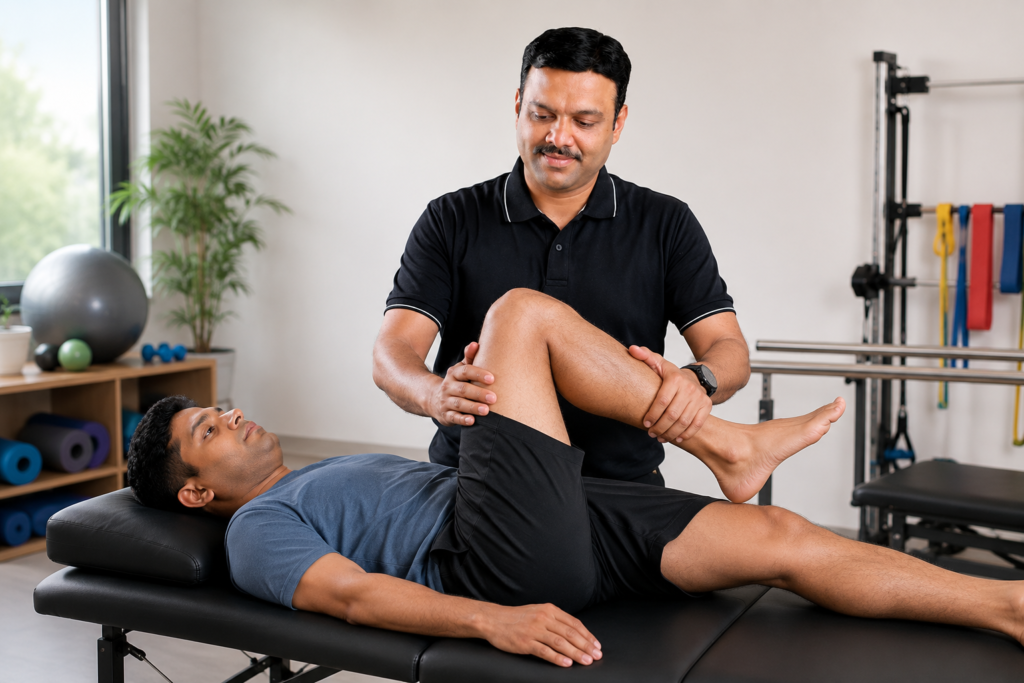
1. You Train Where You Live
Stroke recovery is about relearning real life. Walking on a smooth clinic floor is not the same as walking on your bedroom carpet, stepping over the bathroom threshold, or navigating around your dining table. With neuro physiotherapy at home, every session uses your actual environment — your bed, your chair, your corridor, your kitchen. The skills you practise are the exact skills you need.
2. No Travel Fatigue
Post-stroke fatigue is real and often severe. For many patients, a clinic visit means an hour of preparation, a difficult car transfer, traffic, and a waiting room — all before therapy even begins. By the time the session starts, half their energy is gone. Home visits mean every ounce of energy goes into recovery, not logistics.
3. Family Becomes Part of the Team
In home sessions, spouses, children, and caregivers see exactly what we do and why. I teach safe transfer techniques, correct positioning, and daily home exercises after stroke directly to the people who will support the patient every day. This transforms recovery from a twice-weekly event into a continuous daily process.
4. Comfort, Privacy, and Dignity
Many stroke survivors — particularly elderly patients — feel anxious, embarrassed, or exposed in busy clinic environments. At home, patients relax. And a relaxed patient learns faster, tries harder, and recovers better.
Who Benefits Most from Home Physiotherapy in Dubai?
Home care physiotherapy is ideal for:
- Recently discharged stroke patients who are not yet mobile enough for clinic visits
- Bedridden patients requiring positioning, chest care, and gradual mobilisation — specialised bedridden patient physiotherapy prevents dangerous complications like pressure sores, chest infections, and contractures
- Patients with hemiplegia or paralysis who cannot transfer into a vehicle safely — physiotherapy for paralysis at home removes this barrier completely
- Elderly patients with multiple conditions, for whom travel is exhausting or risky — elderly physiotherapy in Dubai is one of the most requested home services
- Busy families who want therapy scheduled around work, school, and caregiving routines
- Long-term stroke survivors who plateaued after discharge and want to restart structured rehabilitation
If any of these describe your situation, home-based therapy is not a compromise — it is likely the best clinical choice.
What Happens During a Home Physiotherapy Session?
Families are often surprised by how comprehensive a home session can be. Here is what working with a stroke physiotherapy expert in Dubai at home actually looks like:
The First Visit: Assessment and Goal Setting
Your first session is a detailed neurological assessment conducted in your home:
- Muscle strength, tone, and spasticity on the affected side
- Sitting and standing balance
- Transfer ability (bed to chair, chair to toilet, chair to standing)
- Walking pattern and safety
- Sensation, coordination, and posture
- A home safety review — I check for fall hazards, recommend grab rails, and advise on furniture arrangement and equipment
Most importantly, we set goals together. Not vague goals like “get better,” but specific, meaningful ones: walk to the bathroom without help within eight weeks; sit at the family dinner table; pray in a comfortable position; return to the office.
Ongoing Sessions: Structured, Progressive Rehabilitation
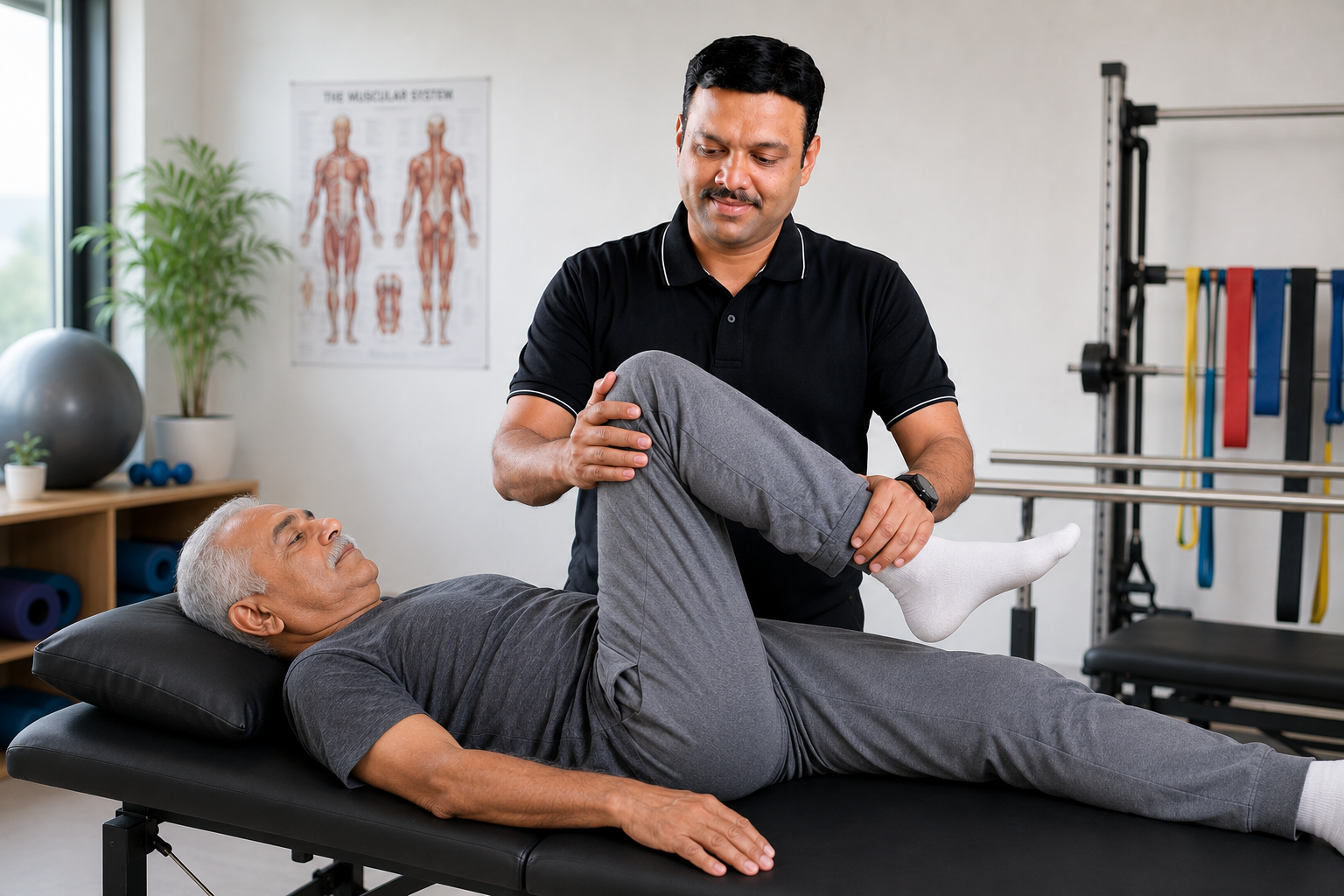
Each session typically runs 45–60 minutes and follows a personalised plan that may include:
- Bed mobility and transfer training — rolling, sitting up, and moving safely between surfaces
- Standing and balance re-education — the foundation of all walking
- Gait training — from first supported steps in the corridor to independent walking, then stairs and outdoor surfaces
- Strengthening of the affected arm and leg using bodyweight, resistance bands, and functional tasks
- Hand and arm retraining with everyday objects — cups, spoons, buttons, door handles
- Spasticity management — stretching and positioning to control stiffness and prevent contractures
- Fall prevention for stroke patients — balance challenges, reaction training, and safe-landing strategies that dramatically reduce fall risk
- Caregiver coaching in every session
Between Sessions: Your Daily Home Programme
I design a simple, safe set of home exercises after stroke for the patient and family to complete daily. These are written down, demonstrated, and reviewed at every visit. Recovery is built between sessions as much as during them — consistency is everything.
The Science: Why Home-Based Stroke Rehabilitation Works
Stroke recovery depends on neuroplasticity — the brain’s ability to rewire itself around damaged areas. Neuroplasticity is driven by three things: repetition, task-specificity, and meaningful practice.
Home rehabilitation is perfectly aligned with all three:
- Repetition — daily home programmes multiply practice far beyond what clinic-only therapy allows
- Task-specificity — practising real tasks (your stairs, your shower, your kitchen) creates stronger, more useful brain pathways than abstract exercises
- Meaning — the brain learns fastest when tasks matter emotionally; reaching for your own coffee cup engages the brain more deeply than touching a cone in a clinic
This is why studies on early supported discharge and home-based rehabilitation consistently show outcomes equal to — and in functional measures often better than — facility-based programmes for suitable patients.
Common Concerns Families Have (And Honest Answers)
“We don’t have any equipment at home.” You don’t need any. Effective stroke rehabilitation uses body weight, gravity, everyday furniture, and simple portable tools that I bring — resistance bands, balance aids, and therapy accessories. Your home is the equipment.
“My father is completely bedridden. Is physiotherapy still possible?” Yes — and it is urgent. Bedridden patients need physiotherapy most. Without it, complications develop quickly: chest infections, pressure sores, frozen joints, and severe deconditioning. Gentle, structured therapy begins in bed and progressively works toward sitting, standing, and beyond.
“It has been two years since the stroke. Is it too late?” No. While the fastest gains occur in the first six months, neuroplasticity continues for life. I regularly see meaningful improvements — better walking, safer transfers, improved arm use — in patients years after their stroke, once structured therapy resumes.
“How is home therapy different from a nurse or caregiver helping with exercises?” Caregivers provide invaluable support, but rehabilitation requires clinical expertise: knowing which movements to train, when to progress, how to manage spasticity safely, and how to correct abnormal patterns before they become permanent habits. A DHA-licensed neuro physiotherapist designs and drives the recovery; caregivers help sustain it.
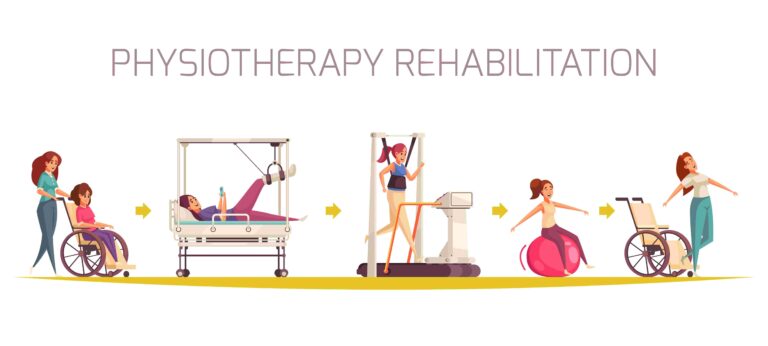
A Real-World Recovery Pathway at Home
To make this concrete, here is how a typical home rehabilitation journey unfolds:
Weeks 1–4: Bed mobility, safe transfers, sitting balance, family training, positioning to protect the affected shoulder and prevent stiffness. Home safety modifications completed.
Weeks 5–12: Standing practice, first steps with support, bathroom independence training, early arm and hand tasks, daily exercise programme established.
Months 3–6: Independent indoor walking, stair practice, outdoor walking, advanced balance work, refined hand function, reduced supervision needs.
Month 6 and beyond: Community mobility, return to hobbies or work where possible, long-term maintenance programme, and periodic review visits to protect hard-won gains.
Every journey is different — some move faster, some slower — but every journey moves forward with structure, expertise, and consistency.
Why Choose neuromotion for Home Physiotherapy in Dubai?
At neuromotion, home-based stroke rehabilitation is not a side service — it is a specialisation:
- Neuro-specialist expertise — focused specifically on stroke, paralysis, and neurological conditions, not general aches and pains
- DHA-licensed, experienced care with hundreds of stroke patients successfully guided through recovery
- Truly personalised programmes — assessed, measured, progressed, and documented at every stage
- Family-centred approach — we train your household, not just the patient
- Flexible scheduling across Dubai — sessions arranged around your family’s routine
- Honest communication — realistic timelines, measurable goals, and genuine celebration of every milestone
Recovery from stroke is a marathon, not a sprint. Having the right expert beside you — in your own home, session after session — makes all the difference between simply coping and truly recovering.
Frequently Asked Questions
How many home physiotherapy sessions per week does a stroke patient need? In the active recovery phase, three to five sessions per week is ideal, supported by a daily home exercise programme. As independence improves, frequency gradually reduces.
Do you cover all areas of Dubai? Home visits are available across Dubai. Contact us through neuromotion.info with your location and we will arrange a convenient schedule.
Can home physiotherapy help with conditions other than stroke? Yes — including Parkinson’s disease, spinal cord injury, multiple sclerosis, traumatic brain injury, post-surgical weakness, and general elderly mobility decline.
What should we prepare before the first visit? Nothing special — just the patient’s medical reports and discharge summary if available, comfortable clothing, and a clear space near the bed or a sturdy chair.
Bring Expert Stroke Rehabilitation to Your Doorstep
Your home should be the place where recovery accelerates — not where it stalls. With professional home physiotherapy in Dubai for stroke patients, hospital-quality rehabilitation continues seamlessly in the environment that matters most, surrounded by the people who matter most.
Visit neuromotion.info today to book a home assessment. One phone call brings expert stroke care to your door — and brings your loved one one step closer to independence.